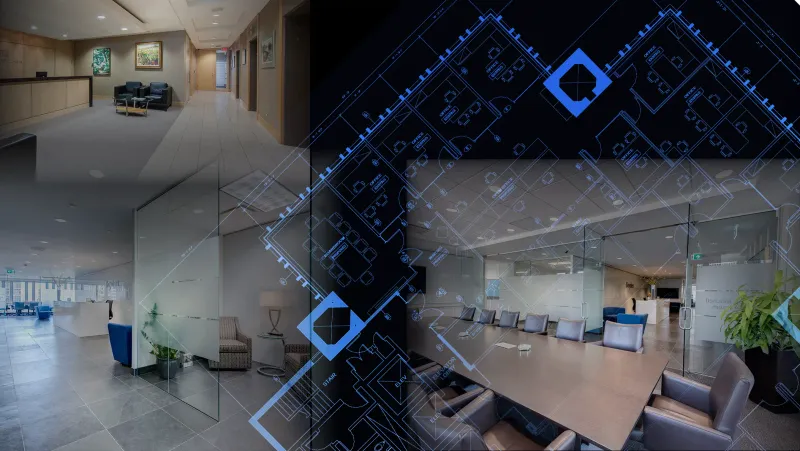
What is a Tenant Improvement (TI)?
When you lease an empty commercial shell or take over a space from a previous business, outfitting it for your specific needs is called a Tenant Improvement (TI). In British Columbia, a TI is rarely just about aesthetics, drywall, and paint. Because commercial spaces are heavily regulated for public safety, almost every TI requires a building permit from the municipality to ensure the design meets the BC Building Code (BCBC) for fire safety, accessibility, and exiting.
The Most Common Mistake: Unplanned "Change of Use"
The biggest mistake business owners make happens before the design even starts—sometimes before the lease is even signed. It's failing to verify the building's previous occupancy classification.
The BC Building Code classifies every business type into a "Major Occupancy" group. For example, a restaurant or daycare is Group A (Assembly), an office or medical clinic is Group D (Business), and a retail store is Group E (Mercantile).
If you are moving a retail store (Group E) into a space that was previously used as an office (Group D), you are triggering a Change of Major Occupancy.
This is critical because different occupancy groups have entirely different code requirements. An Assembly occupancy (like a daycare) requires far stricter fire separations, more washrooms, and superior exiting infrastructure than a standard office. If your TI triggers a Change of Use, the city will force you to upgrade the base building to meet the new standards. Our forensic code analysis catches this early so you can negotiate with your landlord before signing the lease.
When Are Additional Professionals Required?
For many small retail spaces and offices, our team of registered designers can handle the permit drawings entirely in-house. However, specific building criteria will mandate the involvement of other registered professionals:
- Architects (AIBC): Under the Architects Act in BC, a registered Architect is legally required to stamp the drawings if your commercial unit is located in a building that is larger than 4,950 sq ft (460 sq m), is more than 3 storeys high, or if your TI involves a complex Change of Major Occupancy.
- Engineers (EGBC): You will need a Mechanical Engineer if you are modifying HVAC systems or adding commercial kitchen exhaust hoods (NFPA 96). You will need an Electrical Engineer if you are significantly upgrading the electrical panel or lighting loads.
We act as the prime consultant, coordinating these professionals so your permit package is unified and compliant.
Why As-Built Measuring with LiDAR is Critical
Municipalities require your TI permit drawings to accurately reflect the base building's existing conditions. In many older commercial buildings, the landlord's leasing plans are inaccurate, outdated, or completely missing.
You cannot design a code-compliant exiting strategy if your starting dimensions are wrong. To solve this, we perform As-Built Measuring using an advanced LiDAR scanner. Unlike a traditional land survey (which maps the exterior property lines), our LiDAR scan captures the entire interior of the unit, taking millions of measurements and 360-degree photos. This allows us to create precise base building floor plans, eliminating the risk of costly construction conflicts down the line.
Step 1: Define Your Scope & Capacity
Before drafting begins, we need to define exactly what your business operations will look like. We calculate your Occupant Load—the maximum number of employees and customers allowed in the space at one time. This single number dictates how many washrooms you need, how wide your corridors must be, and how many exits are legally required.
Step 2: Verify "Change of Use"
We investigate the city's records to confirm what the space was previously permitted for. By comparing the old occupancy classification to your proposed business model, we identify exactly what fire separation upgrades, barrier-free accessibility improvements, or mechanical changes the city will demand.
Step 3: LiDAR As-Built Scan
If the landlord cannot provide accurate CAD files of the base building, we deploy our LiDAR scanner to digitize the space. This guarantees our proposed design fits perfectly within the existing structural columns, plumbing stacks, and exterior walls.
Step 4: Professional Design & Coordination
We develop the full architectural permit package, including:
- Code-Compliant Space Planning: Optimizing your workflow while maintaining legal exit pathways.
- Reflected Ceiling Plan (RCP): Coordinating lighting, sprinklers, and HVAC diffusers.
- Life Safety & Key Plans: Mapping fire extinguishers, emergency lighting, and unit location for first responders.
If an Architect, Mechanical Engineer, or Structural Engineer is required, we integrate their stamped drawings into our master set.
Step 5: Submit for Permit
Once the design is complete and coordinated, the application is submitted to the municipality. We act as your technical representative, answering questions from the city plan checkers and making any necessary revisions to our drawings to secure your building permit approval.

Canadian Blueprint Inc.
BC Building Design & Permit Drawings
Published July 21, 2025